Old gutters pulling away from the fascia aren’t just ugly — they’re routing rainwater straight into your foundation and walls every time San Diego actually gets a storm. Replacing them costs far less than fixing what water damage leaves behind. Here’s what you’ll actually pay in 2026, and how to get the most out of every dollar.
Average installed cost per linear foot in San Diego
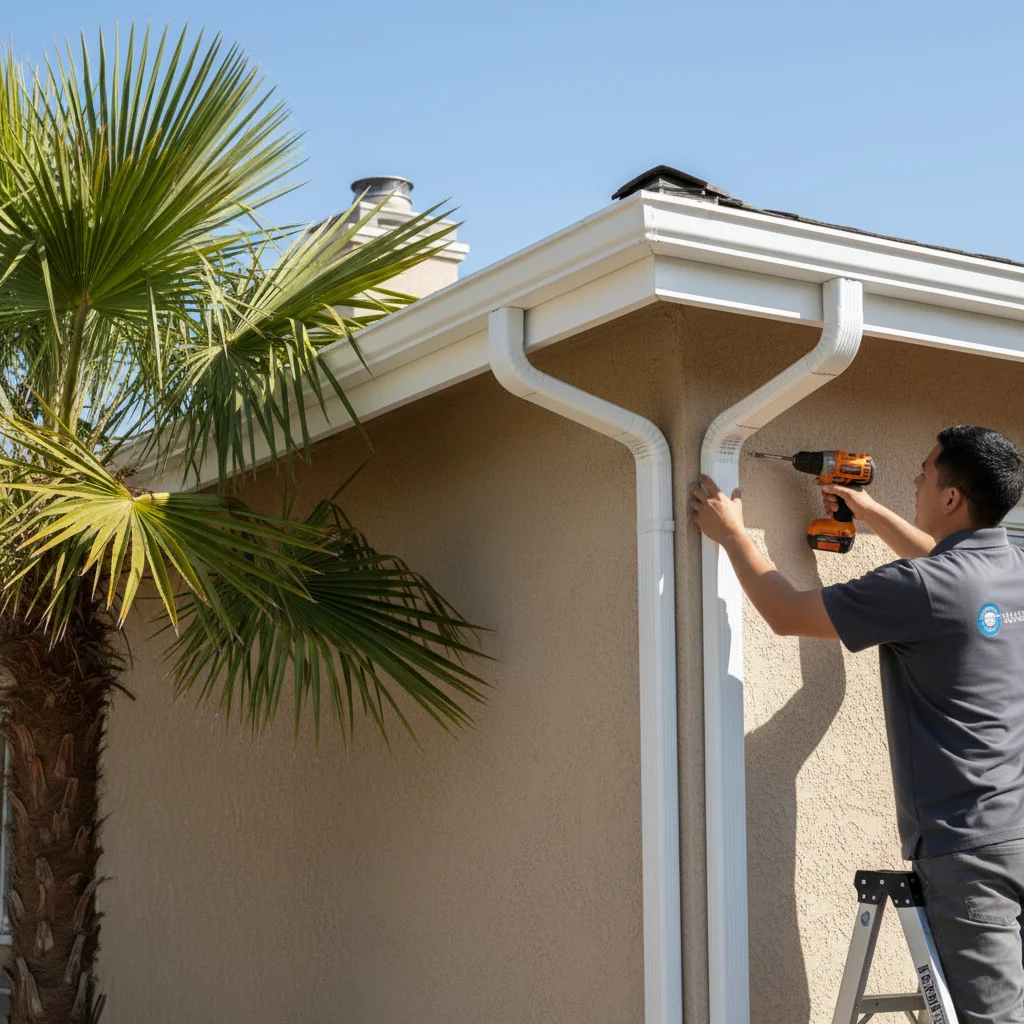
Most homeowners in San Diego County pay between $8 and $18 per linear foot for aluminum gutters, fully installed. That’s the range for the most common job: one-piece continuous aluminum gutters on a single-story house with straightforward roofline geometry.
Here’s a practical breakdown for a typical San Diego home:
- Average home roofline: 150–200 linear feet of gutter
- Aluminum (one-piece, continuous): $8–$14 per linear foot installed
- Steel (galvanized): $9–$16 per linear foot installed
- Copper: $25–$45 per linear foot installed
- Vinyl/sectional: $5–$9 per linear foot installed — but rarely recommended here (more on that below)
So a 175-linear-foot aluminum job lands most homeowners between $1,400 and $2,450 installed. Copper on the same house runs $4,375 to $7,875.
Those numbers assume a standard 5-inch K-style profile. Upgrade to 6-inch gutters — common on homes in hillside neighborhoods that shed water fast — and add $1–$3 per linear foot. Two-story homes add roughly 10–20% for labor due to taller ladder work and safety setup.
Permits for gutter replacement in San Diego are generally not required unless structural fascia work is involved, but it’s worth confirming with the City of San Diego’s Development Services department or the San Diego County permit office if your project touches framing.
Labor alone typically accounts for 40–55% of your total bill. That’s why getting at least two itemized quotes matters — and why bundling gutter work with other roof projects saves real money.
Continuous vs. sectional, aluminum vs. copper
The biggest pricing variable isn’t the material — it’s whether the gutters are one-piece continuous runs or sectional pieces joined by connectors.
Continuous (one-piece) gutters are formed on-site by a machine that rolls a single length of metal to fit your home exactly. No seams between corners means no seams to leak. They cost more upfront than sectional systems, but they almost always perform better over a 10–15 year lifespan, especially in coastal San Diego where temperature swings and salt air accelerate joint failure.
Sectional gutters are the vinyl or pre-cut aluminum pieces sold at big-box stores. They’re cheaper to buy and easy to DIY, but every connector is a future leak point. In a city where a single heavy storm can push 2+ inches of rain in hours, joint failures during peak flow are common. We don’t recommend sectional gutters for permanent installations.
Aluminum is the right choice for most San Diego homes. It’s lightweight, rust-resistant, available in 20+ colors, and holds up well in coastal air. A quality aluminum gutter properly installed should last 20 years with basic maintenance.
Copper is a different conversation entirely. It’s stunning, it develops a green patina over time, and it can last 50+ years. If you’re renovating a Craftsman bungalow in North Park or a Spanish Colonial in Mission Hills, copper gutters match the architecture in a way aluminum can’t. But the cost is real — budget for it from the start, not as an afterthought.
Galvanized steel sits in the middle: stronger than aluminum, but susceptible to rust at cut edges over time. It’s a reasonable choice for high-debris areas (big eucalyptus trees, anyone?), but you’ll want a reputable installer who understands proper end-cap sealing.
When gutter damage is hiding fascia rot
This is the part most gutter quotes miss entirely.
Gutters don’t rot. The wood behind them does. And if your gutters have been pulling away from the house, overflowing, or leaking at the back edge for more than a season, there’s a real chance the fascia board — and sometimes the rafter tails behind it — have absorbed enough moisture to go soft.
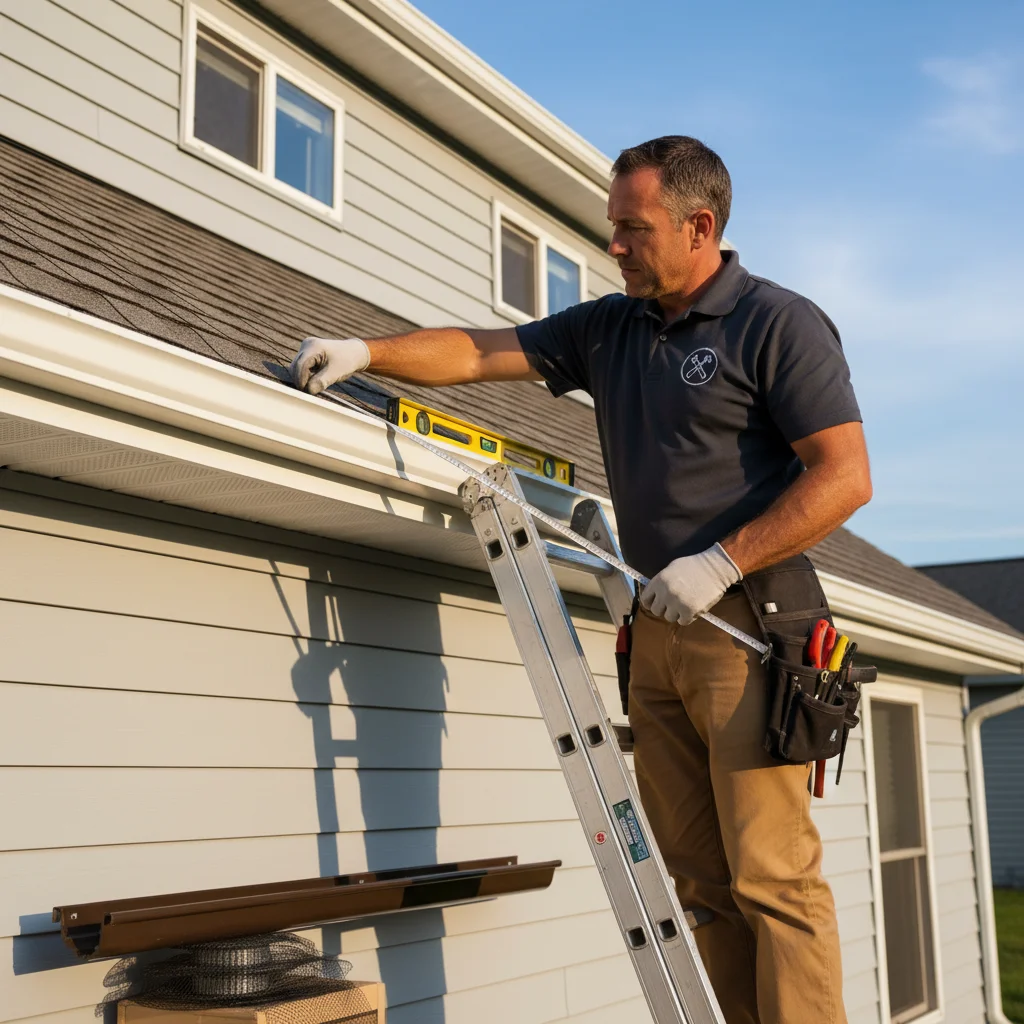
You won’t see fascia rot from the ground. It hides under the gutter lip. Any installer who quotes your gutters without pulling the old ones and checking the fascia condition is skipping a critical step.
Fascia board replacement costs $8–$20 per linear foot depending on whether it’s standard pine, primed composite, or PVC board (PVC is worth the upgrade in moisture-exposed areas). Rafter tail repairs, when needed, run higher and require a licensed contractor.
The reason this matters to your overall roofing picture: the fascia is also where your drip edge terminates. If the fascia is soft, your roof edge protection is compromised. We cover the full drip edge and edge-flashing relationship in our roof inspection checklist for San Diego, which is worth reading before any gutter work starts.
If you discover significant rot at the fascia, that’s also the right moment to assess the adjacent roofing. A roofer — not just a gutter company — should look at the first 12–18 inches of roof deck above the affected area.
Gutter guards: worth it on coastal homes?
Gutter guards are marketed hard. The truth is more nuanced.
In San Diego, the case for gutter guards depends almost entirely on what’s dropping onto your roof:
- Heavy tree debris (Canary Island palms, eucalyptus, Torrey pines): Guards that handle needle-style debris — micro-mesh designs with 50-micron or finer openings — genuinely reduce cleaning frequency from 3–4 times a year to once a year or less.
- Minimal tree cover: Guards add cost without much benefit. Standard gutters cleaned annually are fine.
- Coastal salt air: Some cheaper plastic insert-style guards trap debris against the gutter floor and accelerate corrosion. Avoid them.
Installed costs for quality micro-mesh gutter guards in San Diego run $3–$8 per linear foot added to your gutter project. On a 175-foot job, that’s $525–$1,400 extra. Over a decade, that math often works in your favor if you have significant tree cover — professional gutter cleaning runs $150–$300 per visit.
One honest note: no gutter guard eliminates cleaning entirely. Salt deposits, roof granules from asphalt shingles, and fine organic debris still accumulate. Any company that promises “zero maintenance forever” is overselling it.
For homes near the coast, we also recommend reading our breakdown of how salt air affects roofing materials — the same oxidation that attacks roofing flashings will work on gutter hardware over time.
Bundling with a reroof to save 15–25%
The single best way to reduce your per-linear-foot gutter cost is to schedule the work alongside a roof replacement.
Here’s why the savings are real, not just a marketing claim:
- One mobilization cost. Roofing crews are already on-site with equipment. Adding gutter work doesn’t add setup fees.
- One scaffold/ladder setup. Safety equipment is already staged.
- Drip edge coordination. New gutters should be installed after new drip edge. On a reroof, that sequencing is already built into the workflow — no return trips.
- Fascia access is already open. Roofers remove old drip edge and expose the fascia as part of teardown. Fascia inspection and repair costs less when the access work is already done.
In practice, homeowners who bundle gutter installation with a roof replacement through us typically save $400–$900 compared to scheduling them separately on a 175-foot job. On top of that, it protects the new roof warranty — most manufacturers require proper drip edge and guttering as part of edge water management.
If you’re already evaluating your roof’s lifespan, check out what a new roof costs in San Diego in 2026 to see how the full project pencils out. Doing both jobs at once is almost always the smarter financial call.
One last thing worth verifying: make sure any contractor you hire for this work holds a valid California contractor’s license. You can check license status directly through the CSLB license lookup tool. Gutter work attached to a structure falls under general building contractor scope in California — unlicensed work can void your homeowner’s insurance claim if something goes wrong.
When to call us
If your gutters are pulling away from the fascia, overflowing during rain, or you’re seeing water stains on your stucco or siding below the roofline, it’s time for a licensed roofing contractor to take a look — not just a gutter-only company. Fascia rot, rafter damage, and edge flashing issues need someone who can assess the full roof edge, not just swap the trough. Call us at (858) 925-5546 for a same-day estimate.