You’re getting quotes for a new roof and the contractor mentions architectural shingles. You remember the house had 3-tab when it was built, and you’re wondering whether the upgrade is real or just a sales pitch. It’s a fair question, and the answer has changed a lot in the past decade.
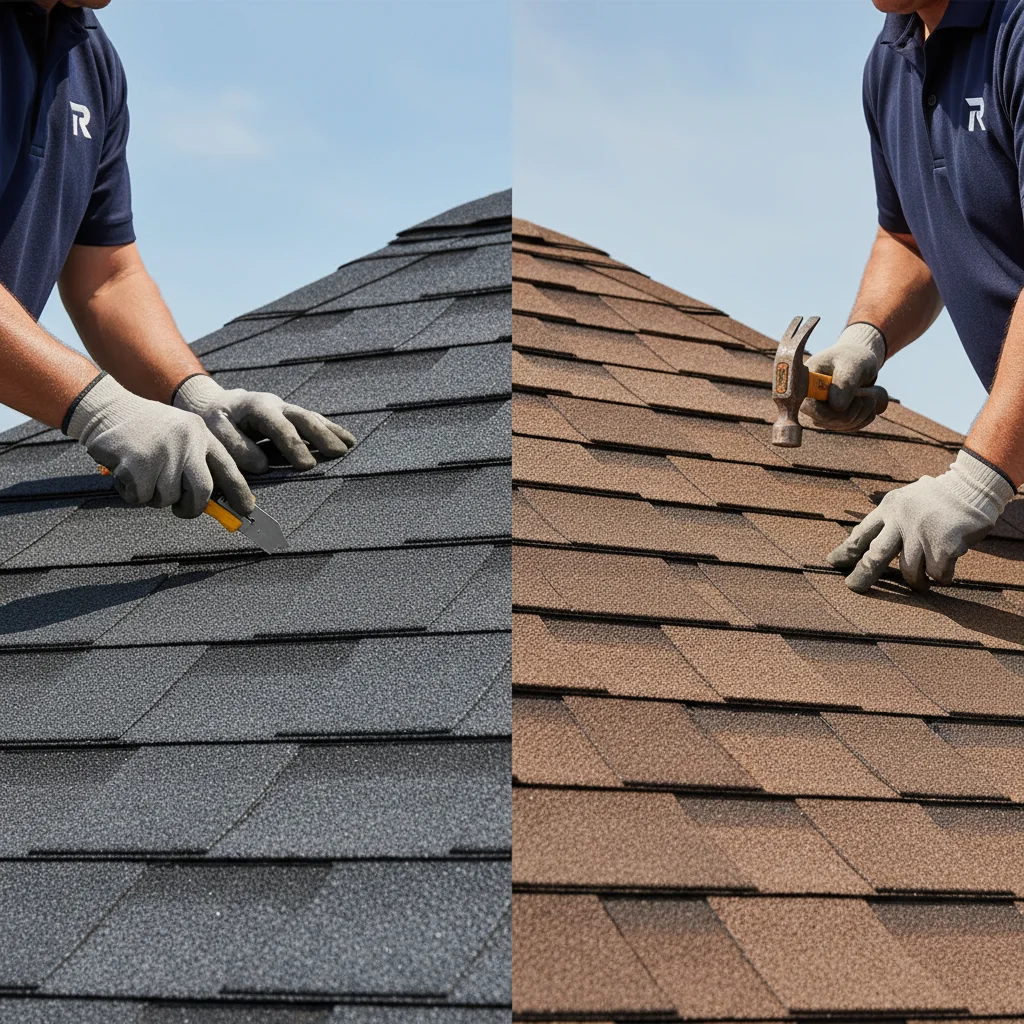
What changed: why nobody installs 3-tab anymore
Three-tab shingles were the default for most of the 20th century. They’re flat, lightweight, and cheap. A single layer of asphalt with three cutouts per strip, uniform across the whole roof. They worked fine in mild climates when labor was cheap and warranties were short.
The market quietly walked away from them. Most major manufacturers — GAF, Owens Corning, CertainTeed — still list 3-tab in their catalogs, but distributors around San Diego County barely stock them. Installers rarely quote them. There are a few reasons for that shift.
First, the price gap closed. In the early 2000s, 3-tab ran meaningfully cheaper per square than dimensional shingles. Today, the material cost difference is roughly $15–$30 per square (100 sq ft), which is almost nothing once you account for labor, tear-off, underlayment, and permits. The upgrade to architectural costs you maybe $200–$400 more on a typical 2,000 sq ft San Diego home.
Second, code and insurance expectations changed. More insurers now require a minimum wind rating of 110 mph for new installs. Standard 3-tab meets 60–70 mph. Most architectural shingles meet 110–130 mph out of the box. Getting a policy renewal or a favorable rate on a 3-tab roof is getting harder.
Third, contractors simply stopped training on them. A 3-tab roof needs perfectly straight courses and very precise nailing — mistakes are visible from the street. Architectural shingles are more forgiving to install and look better even when the job isn’t perfect. The industry moved on.
Architectural shingle cost premium (and what it buys you)
“Architectural” just means the shingle is made from two layers laminated together. That thickness creates a dimensional look — shadow lines, varied tab sizes — that mimics wood shake or slate without the weight or cost. It’s also what makes them heavier, stiffer, and more durable.
For a typical San Diego reroof, you’re looking at these rough ranges per square installed (material + labor, no tear-off):
- 3-tab: $280–$340 per square
- Standard architectural (e.g., GAF Timberline HDZ, Owens Corning Duration): $310–$380 per square
- Premium architectural (e.g., CertainTeed Landmark Pro, GAF Timberline UHDZ): $380–$460 per square
Those numbers shift based on pitch, access, and what’s underneath. For a full picture of what a new roof costs in San Diego right now, the 2026 roof replacement cost guide breaks it down by square footage and material.
What you’re actually buying with the architectural premium:
- A thicker, heavier shingle. Standard 3-tab weighs about 240 lbs per square. Most architectural shingles run 280–390 lbs. That weight means more resistance to wind uplift and better sealing.
- A longer warranty. Three-tab warranties top out around 25 years. Architectural products typically come with 30-year to lifetime limited warranties. The coverage details matter more than the headline number, but it reflects the manufacturer’s own confidence in the product.
- Better algae resistance. Most architectural lines include copper-granule blending (Scotchgard or equivalent). San Diego’s coastal humidity makes algae streaks a real issue — especially in neighborhoods near the bay or Mission Valley marine layer zones.
If you’re choosing between specific brands, the GAF vs. Owens Corning comparison goes deep on what separates their mid-range and premium lines.
Wind, fire, and impact ratings that matter in San Diego
San Diego isn’t tornado country, but it’s not calm either. Santa Ana winds regularly hit 50–70 mph in the inland valleys and foothills. The 2003 and 2007 Cedar and Witch Creek fires showed how fast an ember-driven event can move through a neighborhood. Ratings matter here.
Wind ratings
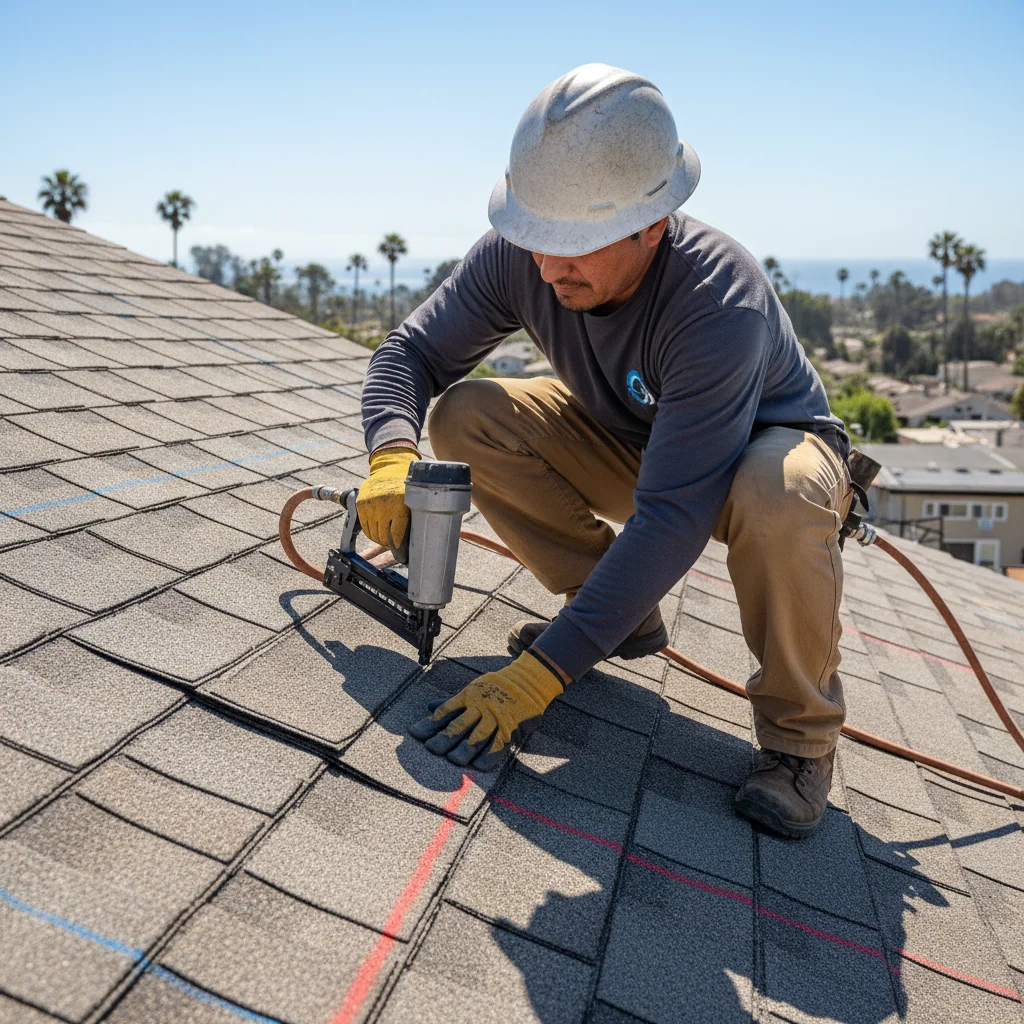
Shingles are rated under ASTM D3161 or D7158. Class H (the highest under D7158) covers 150 mph. Most architectural shingles land at Class F (110 mph) or Class H. Three-tab shingles typically earn Class A under D3161, which corresponds to about 60 mph. For anything near the coast or in Santee, El Cajon, or the foothills where Santa Anas funnel, Class F minimum is worth specifying.
Fire ratings
California requires Class A fire ratings on new roofing installs in most jurisdictions. Both 3-tab and architectural shingles from major manufacturers carry Class A when installed over the correct underlayment. This isn’t a differentiator between the two types — it’s a baseline for both. If you’re in a Very High Fire Hazard Severity Zone (which covers large portions of eastern San Diego County), check that the specific product you’re being quoted carries that Class A designation. The wildfire and ember data for San Diego is worth reading before you finalize a material choice in those areas.
Impact ratings
Most San Diego roofs don’t need impact-rated shingles — hail isn’t a regular threat here the way it is in Texas or Colorado. That said, Class 4 impact-rated products (tested under UL 2218) can earn you an insurance discount in some policies. Worth asking your insurer before your next renewal.
How long each lasts on a real coastal roof
Manufacturer warranties are written in controlled conditions. San Diego’s coastal environment is not controlled.
Salt air accelerates granule loss on shingles within 1–3 miles of the ocean. UV exposure is high year-round. The marine layer means roofs near the coast cycle through moisture and drying more often than roofs in, say, Phoenix. That cycling matters for adhesive strips and granule bonding.
In practice, what we see in San Diego:
- 3-tab shingles: 15–20 years on a coastal or near-coastal roof. Maybe 22–25 years inland (Escondido, Santee, El Cajon) if well ventilated.
- Standard architectural shingles: 22–28 years coastal, 28–35 years inland.
- Premium architectural shingles: 25–32 years coastal, 35+ years inland with proper ventilation and maintenance.
The coastal aging post has actual granule-loss data from San Diego roofs that tracks how much faster degradation happens within that coastal mile band. If your house is in Ocean Beach, Pacific Beach, Coronado, or anywhere within a mile of the bay or ocean, those numbers should anchor your decision.
Ventilation plays a bigger role than most homeowners expect. A poorly ventilated attic traps heat that bakes shingles from underneath and cuts years off any product’s lifespan. If you’re reroofing, it’s the right time to audit ridge vent and soffit vent coverage.
When a shingle upgrade makes sense before reroofing
The straightforward answer: if you’re doing a full reroof anyway, always go architectural. The cost difference is small enough that there’s almost no scenario where 3-tab makes financial sense on a new installation. You’ll get a longer warranty, better wind performance, and a product that actually holds its resale value.
The trickier question is whether to upgrade when you’re doing a repair rather than a full replacement. If your roof has 5–8 years of life left and you need to patch a section, matching existing 3-tab is fine — you’re not reroofing yet. If your existing 3-tab is 15+ years old and you’re repairing more than 10–15% of the surface, that’s usually the moment to have a real conversation about full replacement instead.
Our asphalt shingle roofing service covers both repair and full replacement, and we can give you an honest read on which makes more sense for your specific roof. We don’t push replacements when a repair is the right call — and we’ll tell you if 3-tab is actually fine for your situation.
For a broader look at whether repair or replacement is the right move, the roof repair vs. replace guide walks through the decision framework in detail.
One thing worth noting: if you’re pulling permits through the City of San Diego or unincorporated county, the San Diego County permit office requires that replacement roofing meet current energy and fire codes. Architectural shingles with ENERGY STAR certification may also help you meet California Title 24 cool-roof requirements depending on your roof slope and climate zone.
When to call us
Choosing between shingle types is one decision — actually getting the install right is another. Nailing patterns, starter strip placement, and proper underlayment all affect how long even a premium shingle performs, and those details require a licensed contractor who knows San Diego’s specific code requirements. If your roof is 15 years old or older, or you’re seeing granule loss, curling edges, or daylight in the attic, don’t wait for the next rain to find out what shape it’s in. Call us at (858) 925-5546 for a same-day estimate.